Are you confused about electromagnetic field (EMF) exposure and its potential effects on you, your home, and your family?
Or do you want to buy an EMF meter but don’t understand the technical specifications and uses?
Yes? Great, you’re in the right place!
In this guide, we will cover:
- What are EMFs?
- The health risks and symptoms associated with them
- EMF meters you can use to detect levels of EMFs in your environment
- Ways to protect from those EMFs
First things first
Like many, you probably already know that EMFs are not harmless. And with the World Bank estimating that over 90% of the global population is exposed to electricity, even if you do not live in a crowded city, they are likely an issue in your everyday life.
We should also note that over 80% of the countries surveyed by the World Health Organization set limits on EMF exposure, so the concerns are well-known.
However, the myths and misinformation surrounding EMF exposure make it difficult to separate what is false from the reliable information and valid concerns.
EMF Protection is committed to providing accurate and up-to-date information so you can protect yourself and your loved ones from EMFs and live well in the electromagnetic world in which we now live.

Understanding EMF Meters
A standard EMF meter is a scientific device for measuring or detecting radio frequencies and electric/magnetic fields for research or personal home use.
Most EMF meters read alternating current (AC) electricity, the standard current in homes and devices that is more common than direct current (DC).
Different EMF meters will also measure certain fields and hertz frequencies (the unit of measurement for wavelengths). The hertz frequency range is a significant factor when considering which EMF meter to buy.
For personal use, an EMF meter can help you identify the type, severity, and source of your EMF exposure so you can choose the appropriate EMF protection.
For example, you may discover that you do not need 5G protection, you are dealing with severe exposure to dirty electricity, or your WiFi network and cell phone are affecting your sleep.
When you understand what a model measures, how it displays the data, and where it can be used, you’ll have greater clarity when selecting your EMF meter to detect electromagnetic radiation.
What Does an EMF Meter Actually Measure?
This is one of the most common questions people ask when they start looking into EMF protection for the home, and it is a fair one, because the answer is not as straightforward as you might expect.
Different meters measure different things. Some focus on a single field type; others cover multiple field types in one device. Here is a quick breakdown:
- Radio frequency (RF) radiation — emitted by mobile phones, Wi-Fi routers, smart meters, cell towers, Bluetooth devices, and wireless technology of all kinds
- Magnetic fields — generated by electrical current flowing through power lines, electrical wiring, and home appliances
- Electric fields — present wherever there is voltage, even when a device is switched off
- Dirty electricity — high-frequency interference that travels along your home’s wiring, often caused by energy-efficient bulbs, solar inverters, and variable-speed devices
Not every meter covers all of these. That is why many people end up owning more than one device: a dedicated RF meter for wireless signals and a separate meter for electric and magnetic fields from wiring and power lines.
If you are only just starting out, a meter that handles multiple field types will give you the broadest picture of your EMF environment without needing to invest in several tools at once.
Evaluating an EMF Meter
An EMF meter is available in two types: a single-axis or tri-axis. A single-axis EMF meter is usually cheaper but takes longer to make measurements. A tri-axis is more expensive but measures all three EMF axes at once.
Other factors include detection and data displays. Regarding these, there is no right or wrong, so you can choose what works best for you.
Detection
An EMF meter can detect radio frequencies, magnetic fields, electric fields, or a combination of the three. (Some measure all three simultaneously.)
A radiofrequency EMF meter reads the EMF generated by wireless networks and devices. There are now a number of EMF meters that can also detect current 5G frequencies.
Electric and magnetic EMF meters measure EMF from electrical wiring, lines, and devices, as well as solar panels and EMF-emitting lights.
There are also specialty EMF meters for measuring dirty electricity, the electrical pollution caused by interruptions to electrical flow.
Frequency Range
The range of the EMF meter is important because different sources use different frequencies.
Radio frequencies are between 3 kHz and 300 GHz (according to the WHO), although different devices are restricted to certain frequencies.
Home WiFi networks use 2.4 GHz or 5 GHz (not to be confused with 5G). LTE cell phones use the 800 MHz, 1800 MHz, and 2600 MHz radio frequencies.
5G networks use higher frequencies compared to other networks. A low-level EMF meter will not detect 5G radiation.
The average power grid frequency in North America is 60 Hz, while most other countries use 50 Hz.
An EMF meter that reads below 20 Hz isn’t generally necessary for home use.
Accuracy and Sensitivity
The accuracy and sensitivity levels can make the EMF meter difference for people with EMS. Some EMF meters focus more on sensitivity and/or accuracy than others, which may prioritize being more versatile and providing powerful readouts.
People with EMS will benefit from at least one EMF meter with a low margin of error and high sensitivity. Weighted measurements, which account for the EMF levels in human bodies, can also show a clearer picture of EMF exposure.
Data Display
Some EMF meter data displays use generalized ranges with lights and color codes so the EMF type and exposure severity are instantly recognizable. Others use exact numbers and multiple readings for greater accuracy.
A few EMF meters also have audible cues for determining different frequencies or sources. These may use different tones, volumes, or sounds.
Warranty
The cost of an EMF meter is variable, ranging from $20 for low-end basic models to around $200-$500 for the more accurate scientific models.
A reliable and accurate EMF meter with valid results is worth the investment. Reputable EMF meter companies will offer a warranty, which will help protect your investment.
Choosing the Best EMF Meter: A Side-by-Side Comparison
There is no single best EMF detector for every situation. The right tool depends on what you are trying to measure, your budget, and how much technical detail you want from your readings.
To make it easier, here is a comparison of the key specs across the meters we carry:
| Meter | Field Types Measured | Frequency Range | Best For | Price Range |
| FM5 Path 5G Monitor | RF | 1 MHz–10 GHz + 24–32 GHz (mm wave) | 5G detection, cell towers, smart meters | ££££ |
| TriField TF2 | RF, Magnetic, Electric | RF 20 MHz–6 GHz | Most home users wanting all three field types in one device | £££ |
| EPE Conseil Cemprotec 31 | RF | 1 MHz–10 GHz | Cell towers, Wi-Fi, 5G, Smart meters | £££ |
| EPE Conseil Cemprotec 32 | Magnetic, Electric | 10 Hz–5 kHz | Wiring, power lines, broadband | £££ |
| Dirty Electricity Line EMI Meter | Dirty electricity | 10 kHz–10 MHz | Plug-in AC testing for electrical pollution | £££ |
| EPE Conseil Cemprotec 34 | RF, Magnetic, Electric | 10Hz –10 GHz | Detailed dirty electricity measurement, 85–250V | £££ |
A few things worth keeping in mind when choosing the best EMF meter for your needs:
- Frequency range matters. A cheap meter with a limited range will miss sources entirely. If you are concerned about 5G or millimeter wave signals, you need a meter specifically built to detect those higher frequencies, as most consumer meters simply cannot reach them.
- Accuracy vs. versatility. Some meters sacrifice precision to cover more ground. If you have electromagnetic sensitivity (EMS), accuracy and sensitivity should come first.
- Long-term durability. A higher price point often reflects build quality and warranty support. Cheap meters can give inaccurate readings or fail quickly, which is not ideal when you are relying on them to make informed decisions about your home environment.
Finding Reputable EMF Meters
You can buy a super cheap EMF meter from Walmart or Amazon, but putting your health in the hands of those models is risky. They generally detect fewer EMF sources with lower accuracy.
EMF Protection currently offers seven reputable and highly-reviewed models that can fulfill different specifications and needs.
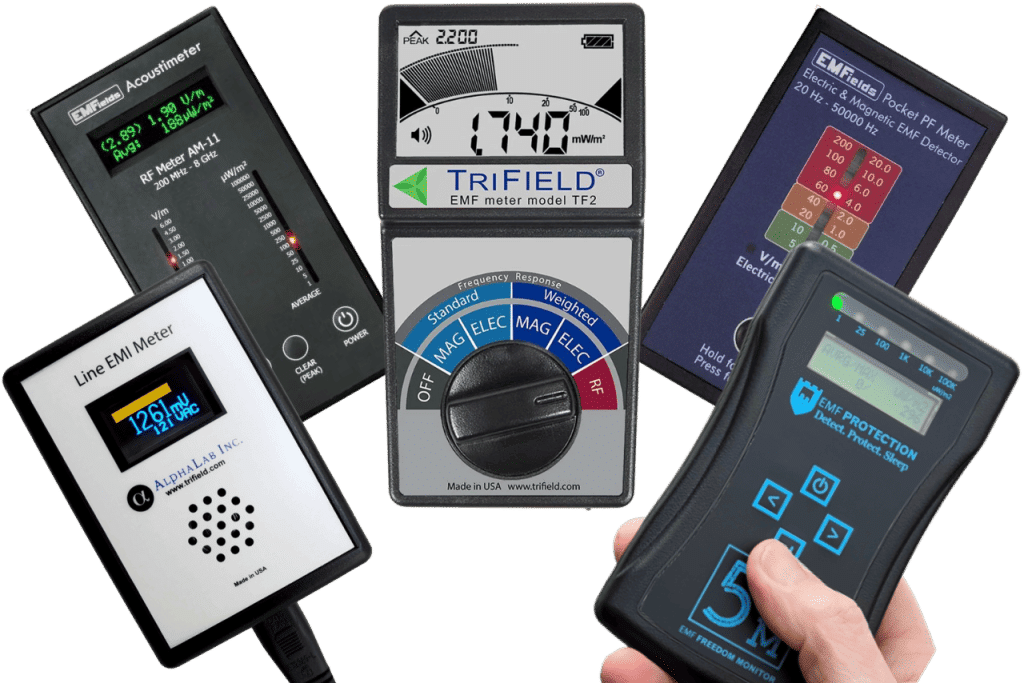
EMF Protection only provide reputable EMF Meters
1. FM5 Path 5G Monitor
This is the world’s first sensitive hand-held and affordable 5G millimetre wave monitor and it comes with a second antenna slot upgradeable for future mm wave technology.
Use to detect Cell towers, including mm wave 5G Cell phones, cordless phones, smart meters, Wifi, IOT, etc. Click to watch video: How to Use the FM5 5G Monitor
- Quick response time – measurements taken thousands of times per second.
- Peak and maximum signal strength shown on LED screen.
- Directional antenna enables highly accurate HF screening.
- Audio speakers allow signal identity and direction tracing.
- Low frequency module frequency range 1 MHz to 10 Ghz
- Low freq. sensitivity 1uW/m2 to >100k uW/m2
- High frequency range 24 GHz to 32 Ghz.
- High freq. sensitivity 30uW/m2 to >100k uW/m2.
- Audio range 40Hz to 16kHz.
2. TriField TF2 EMF Meter
Measures: Radio Frequency, Magnetic Fields, Electric Fields Range: RF 20 MHz-6 GHz, M 40 Hz-100 kHz, E 40 Hz-100 KHz Accuracy: RF ±20%, M ±4% @ 50/60 Hz, E ±5% @ 50/60 Hz Sensitivity: RF 0.001 mW/m^2, M 0.1 milligauss, E 1 V/m
The TF2 is a high-performance, tri-axis EMF meter that can use standard or weighted measurements for determining more precise EMF levels. It can also detect some 5G installations.
Along with weighted measurements, the EMF meter’s LCD display features large-size precise numbers of peak readings and current readings for additional accuracy.
3. EPE Conseil Cemprotec 31
Measures: Radio Frequency Range: 1 MHz-10 GHz
The Cemprotec 31 is a fast, sensitive, and powerful EMF meter. It can detect 5G networks and both WiFi and WiMax frequencies. Because of its high sensitivity, it is useful for dealing with EMS.
Its EMF meter display includes LED lights. It uses audio signals to help you discover the EMF source.
4. EPE Conseil Cemprotec 32
The EPE Conseil Cemprotec 32 EMF Meter will measure Low Frequency Fields (electric and magnetic) from 10 Hz to 5 kHz, and DE signals and PLC (Power Line Communication) frequencies from 1.6 MHz to 68 MHz with a very high sensitivity.
The EMF meter display features an easy-to-read and color-coded scale. You can quickly determine if EMF levels are too high without comparing numbers.
5. Dirty Electricity Line EMI Meter / Monitor
Measures: Dirty electricity, Range: 10 KHz-10 MHz, Accuracy: Voltage +/- 1 VAC, Line Noise +/- 8% @ 20 KHz TO 2 MHz Sensitivity: 0.1 mVp-p
This EMF meter measures the electrical pollution in your home by testing AC currents. It plugs into an electrical socket to determine the signal interference.
The display of this EMF meter features both number readouts and a large front speaker for emitting sounds that correlate with intensity. The higher the intensity goes up, the louder the sounds from the speaker. Watch demonstration video here.
6. EPE Conseil Cemprotec 33
The EPE Conseil Cemprotec 32 EMF Meter will measure High-frequency radiation between 1Mhz up to 8GHz, and low-frequency radiation (Electric, Magnetic) between 10Hz up to 5KHz.
The EPE Conseil Cemprotec 34 EMF Meter will measure high-frequency radiation between 1Mhz up to 10GHz (Wi-Fi, Smart meters, 4G, 5G etc.)
Low-frequency radiation (Electric, Magnetic) between 10Hz up to 5KHz
Using EMF Meters for EMF Protection
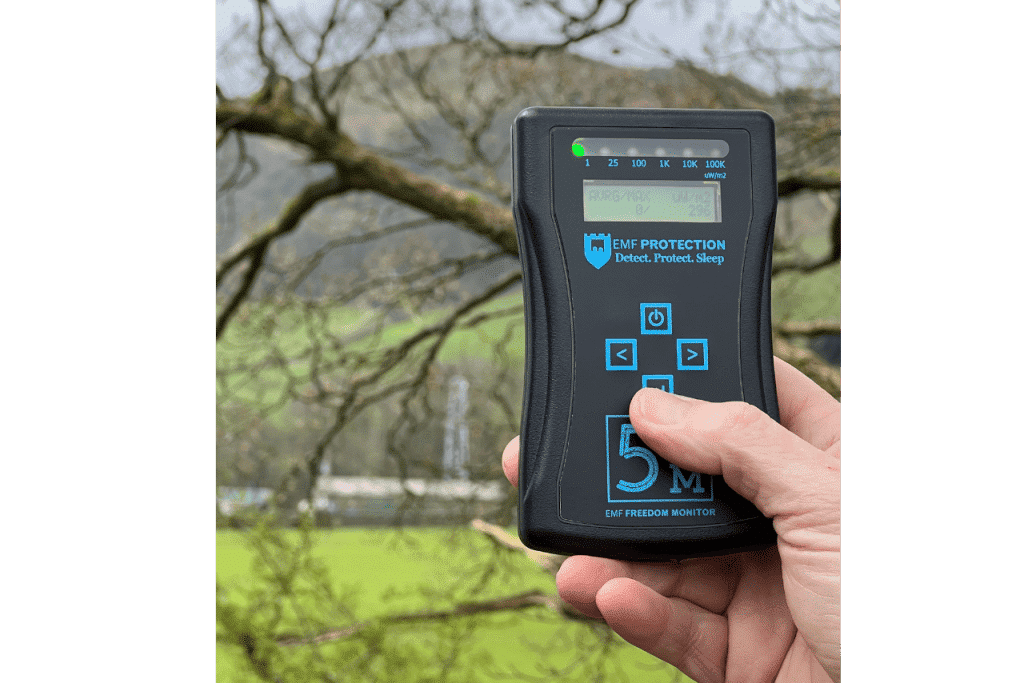
The FM5 Path 5G Monitor
How to Use an EMF Meter at Home
Getting useful results from your EMF meter does not require a science degree. A bit of method goes a long way.
Start with a baseline. Before you begin testing near devices, take a reading in the centre of a room with everything switched off. This gives you a reference point.
Move systematically. Work through your home room by room. Pay particular attention to:
- Bedrooms, particularly around the bed, where you spend the most time
- Areas near Wi-Fi routers, smart meters, and fuse boards
- Rooms with a lot of wireless devices
- Walls shared with neighbours, which may have wiring or meters on the other side
Note distance. EMF radiation drops off significantly with distance. Move your meter closer to and further from suspected sources to understand the pattern. Even a metre or two can make a meaningful difference to power density readings.
Test at different times. RF radiation from cell towers and wireless devices can fluctuate throughout the day. Testing at different times gives you a more reliable picture of your actual EMF exposure.
Use the right meter for the job. An RF meter will not pick up dirty electricity, and a dirty electricity meter will not detect wireless signals. If you are using a single-axis meter, you will need to rotate it across all three axes manually to get complete magnetic field readings. A tri-axis model does this automatically.
Once you have identified your main sources, you can look at realistic steps to reduce exposure, whether that is repositioning your router, adding shielding, or filtering dirty electricity at the source.
Contact Us
EMF Radiation Reduction for a Healthier Life
The best EMF meter for your situation will give you valuable peace of mind about your EMF radiation exposure. Check out our range of EMF Meters that we trust.
Safeguarding yourself and your family against EMF exposure doesn’t do any harm and has the potential to do a lot of good.
If you have further questions, contact us. We are a family-run business with extensive experience in this field. We are committed to providing excellent service and support – check out our ‘Great’ TrustPilot rating.
FAQs
An EMF reader gives you accurate, real-time measurements of the electromagnetic fields in your environment, but it does not make a judgement call on your behalf. What it does do is give you the data you need to make that call yourself. You can compare your readings against the exposure guidelines set by bodies like the WHO and take practical steps towards EMF radiation protection if levels are higher than you are comfortable with. Knowledge is the starting point for everything else.
Ionising radiation, such as X-rays, carries enough energy to remove electrons from atoms and is known to damage human tissue. The EMF radiation produced by mobile devices, Wi-Fi, power lines, and electrical wiring is non-ionising radiation, meaning it does not carry that same level of energy. Non-ionising radiation protection is still a valid concern though. The scientific evidence on the long-term effects of human exposure to extremely low frequency (ELF) fields and radiofrequency radiation is still developing, and the precautionary approach is widely recommended, particularly for children.
The honest answer is that research is ongoing. The health effects of prolonged human exposure to EMF radiation, particularly from mobile devices and wireless networks, are still being studied. What we do know is that organisations including the WHO and the International Agency for Research on Cancer (IARC) have flagged radiofrequency fields as a possible carcinogen, and that exposure limits exist in over 80 countries for a reason. Until the picture is clearer, reducing unnecessary EMF exposure where you reasonably can is a sensible and low-effort step to take.