
You can feel your home when it hums. The router ticking in the hall. A laptop warm on your lap. Your phone buzzing in your pocket.
If you have ever wondered which of these sources matters most, how to measure them, and what to do without upending your life, this guide walks you through it.
At EMF Protection, we have helped thousands of American households since 2004 make calm, practical choices that reduce exposure while keeping modern life working. We test before we recommend, and we only sell shielding we can prove with a meter.
What EMF Emission Means Across the Electromagnetic Spectrum
Electromagnetic fields are produced whenever electricity flows.
- Electric fields are measured in volts per meter and exist even when a device is on but not drawing current.
- Magnetic fields are measured in microtesla or milligauss and are produced by current.
Both electric and magnetic fields decrease as you increase distance from the source. That single fact does most of the work in this guide.
Picture the electromagnetic spectrum as a ladder of frequency ranges:
- Extremely low frequency EMFs from power lines and electrical appliances
- Mid frequency EMFs from sources like induction cooktops
- Radio waves used for radio and television signals, Wi-Fi, Bluetooth, and cell phones
- Infrared radiation, visible light, and ultraviolet radiation
- X rays and gamma rays at the very top
The upper bands are ionizing radiation. They carry enough energy to break chemical bonds.
Because every band is technically called radiation, the word alone tells you little. What matters is the split between ionizing and non ionizing EMF radiation.
The bands we live with at home are non ionizing radiation. They do not have enough energy to ionize matter, yet they still interact with the body through electric fields and magnetic fields.
Agencies often shorten all this to electromagnetic fields EMF, the shorthand we use throughout. The World Health Organization and the Environmental Protection Agency both maintain foundational definitions of electromagnetic energy and exposure.
For a familiar reference point, the earth’s magnetic field is a steady background your compass relies on every day.
When clients ask EMF Protection about a device’s EMF emission, they really want three answers: which part of the spectrum it uses, how strong the electric and magnetic fields are near it, and how fast those levels drop with distance.
What EMF Exposure Means for Human Health
Two buckets of radiation are in play.
Ionizing radiation, such as x-rays and gamma rays, is well documented to raise cancer risk at sufficient doses because it breaks chemical bonds.
Non-ionizing radiation covers the extremely low frequency fields from wiring and electrical devices, plus the radiofrequency EMFs from wireless gear.
Cell phones and mobile phones emit radio frequency electromagnetic fields. Rf EMF exposure near the body is measured as the specific absorption rate, or SAR, in watts per kilogram.
What the major agencies actually say
- WHO and IARC classify radiofrequency electromagnetic fields as possibly carcinogenic to humans (Group 2B), based on limited evidence of glioma, a form of brain cancer, among heavy mobile phone users (IARC, 2011).
- The National Cancer Institute reports the scientific evidence on cell phones and cancer as mixed, with most studies showing no clear association (NCI).
- On electromagnetic fields and cancer, the NCI notes that extremely low frequency exposures show an increased risk of childhood leukemia above roughly 0.3 to 0.4 microtesla, though no mechanism has been identified (NCI).
- The National Institute of Environmental Health Sciences describes the overall evidence for human health risk from ELF fields as weak, while not ruling out a small leukemia hazard (NIEHS).
You will also see the National Toxicology Program animal studies cited often.
In those long, high exposure projects, animals received whole body doses far above human limits, and the NTP found some evidence linking radiofrequency radiation to heart tumors in male rats (NTP; NIH).
Questions about breast cancer, increased risk, and other adverse health effects and health outcomes remain under study in ongoing epidemiological studies. Across the scientific literature, research organizations agree the picture is incomplete and that further research is needed, which keeps these possible health risks on the agenda of current health risk assessments.
Public health guidance today rests on exposure limits that separate general public and occupational exposures, with wide safety factors built in.
Our stance at EMF Protection is practical, not alarmist. We respect the agencies, follow exposure limits, and help households lower unnecessary EMF exposure where it is easy. Usually that means managing distance and time near sources.
How to Measure EMF at Home
You do not need to be an engineer to map your environment. After two decades of in-home surveys, we can tell you most problems are solved by measurement, not gadgets.
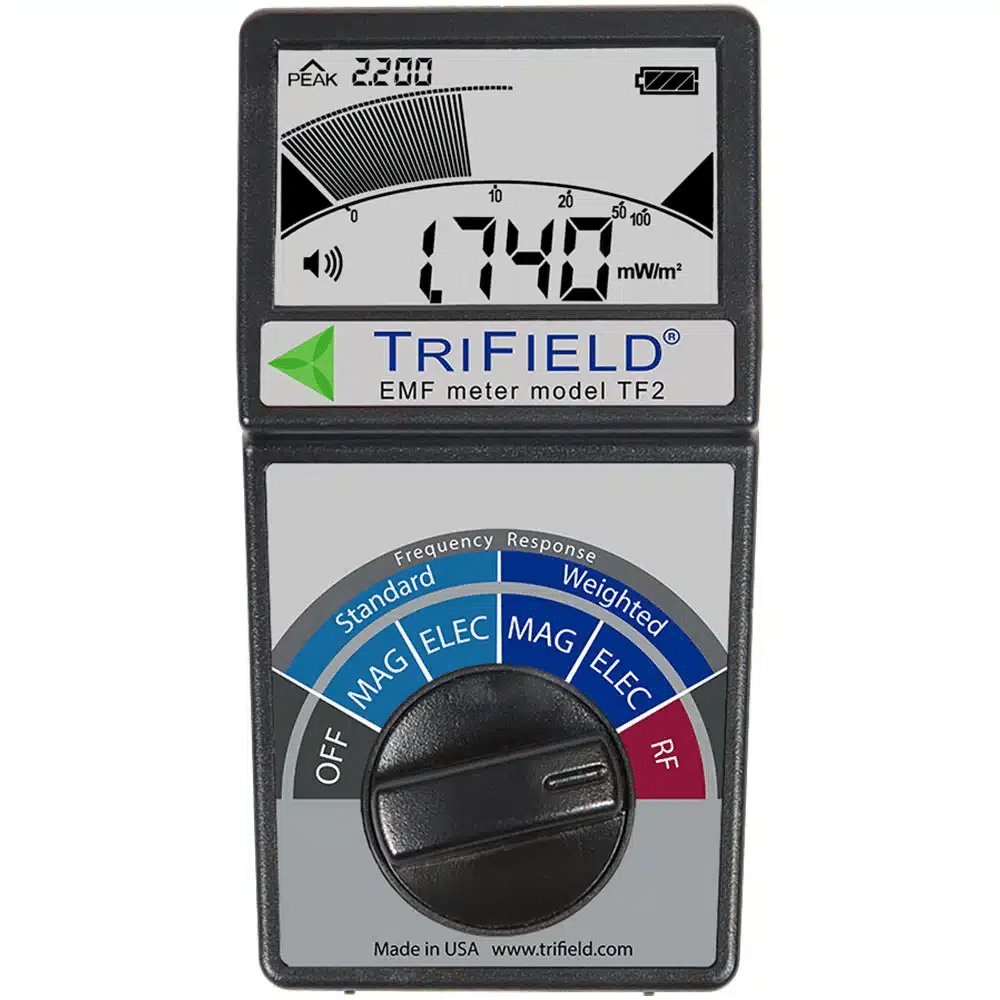
A beginner can use a TriField TF2 or a similar EMF meter to scan electric fields, magnetic fields, and radiofrequency EMFs. Readings fall quickly with increasing distance, so test where you sit, sleep, and work.
Units at a glance
- Electric fields: volts per meter
- Magnetic fields: microtesla or milligauss
- RF power density: watts or microwatts per square meter
- SAR: watts per kilogram for on-body phones and wearables
The protocol our technicians use
- Sleep zone: Measure at the pillow with lights on, then off. Check for static electric buildup from bedding or chargers. Log peak and average.
- Nightstand: Scan chargers, power strips, and cordless phone bases for mid frequency EMFs.
- Desk: Measure the laptop bottom panel, keyboard, and power brick. Test Wi-Fi off versus on.
- Router: Record RF power density at 0.5, 1, and 2 meters.
- Kitchen: Check the induction coil edge at hand distance. Survey the microwave door seam while it runs.
- Whole home: Walk exterior walls facing smart meters or cell phone towers. Note background near power lines and electric power lines.
If you hear buzzing from dimmers or chargers, a dirty electricity meter can flag high frequency transients. Add a filter only after you confirm a real problem.
Household Device EMF Emission at a Glance
| Device or source | Frequency range | Primary field type | Near-source reading | Distance to reduce exposure |
| Phone EMF emission | 700 MHz to 3.8 GHz | Radiofrequency electromagnetic fields | SAR up to 1.6 W/kg at the head per FCC | Speakerphone, wired headsets, airplane mode |
| Bluetooth EMF levels | 2.4 GHz | Radiofrequency radiation | Lower power density than a phone at 10 cm | Add distance, remove when unused |
| Router EMF emission | 2.4 and 5 GHz | Radiofrequency EMFs | Measurable at 0.5 m | Place 2 to 3 m from bed or desk |
| Laptop EMF emission | 50/60 Hz, kHz, plus 2.4/5 GHz | Extremely low frequency magnetic fields plus RF | Elevated at the bottom panel | Use a desk, wired ethernet |
| Induction cooktop | 20 to 100 kHz | Magnetic fields | Higher at the coil edge | Keep hands 10 to 20 cm away |
| Microwave ovens | 2.45 GHz | Electromagnetic radiation | Contained by shielding | Stand 1 to 2 m back, check door seals |
| Smart meter | 900 MHz or 2.4 GHz | Radiofrequency radiation | Short duty cycle peaks | Mount on exterior wall, away from bedrooms |
| Power lines | 50/60 Hz | Extremely low frequency magnetic fields | Higher under high voltage transmission lines | Increasing distance reduces levels |
How Much EMF Each Device Emits and How to Reduce It
Phone EMF emission
Phone RF exposure peaks during calls and during data bursts in weak signal areas.
The FCC SAR limit for phones in the US is 1.6 watts per kilogram, averaged over 1 gram of tissue (FCC). Speakerphone, texting, or air tube headphones are easy wins.
Three quick tests we run:
- Voice call at the ear versus speakerphone at 30 cm
- Streaming video at arm’s length versus downloaded playback in airplane mode
- Nightstand idle versus airplane mode overnight
If cell phone towers face your windows, our EMF window film or EMF protected glass helps. For commuters, an EMF cap plus carrying the phone in a bag rather than a pocket makes a measurable difference.
Bluetooth EMF levels
Bluetooth runs at 2.4 GHz with low power that duty cycles on and off in short packets. At the same distance it usually produces lower power density than a phone.
The catch is proximity. Earbuds sit in the ear canal for hours.
Compare power density at 10 cm from a phone call against earbuds playing audio, and you will see why we favor air tube headphones, which give a wired experience with no metal at the ear.
Laptop EMF emission
Laptops create extremely low frequency magnetic fields near the bottom panel and power brick, especially under load. They add RF when Wi-Fi and Bluetooth are on. Their screens, like other liquid crystal displays, add little by comparison.
Contact readings can be an order of magnitude higher than at 30 cm.
Simple fixes:
- Use a desk instead of your lap, with an external keyboard and mouse
- Run wired ethernet where you work most
- Add a tested barrier such as our EMF shielding fabric or BlocSilver lap panels when you need one
Router EMF emission
Routers emit continuously while on. RF power density falls with the square of distance, so moving a router from 0.5 to 2 meters is a large reduction.
We map RF at 0.5, 1, and 2 meters to pick a spot, then add a timer plug to power it down at night. In most homes a simple reposition is the best answer.
Induction cooktop
Induction cooktops create magnetic fields in the 20 to 100 kHz range that couple into ferrous cookware. Readings are highest at the coil edge where your hands work.
Keep hands 10 to 20 cm away and use compatible, flat-bottom cookware that couples efficiently.
Microwave ovens
Microwave ovens are shielded boxes built to contain electromagnetic radiation at 2.45 GHz. Door seal integrity is what matters.
We survey the door seam during operation and recommend standing 1 to 2 meters back. If the unit is old or the door is bent, replace it.
Smart meter
Most smart meters send brief bursts with a short duty cycle, so average indoor exposure is often low. Peaks are detectable close to the device.
We log readings over 24 hours to understand the profile. If a meter sits on a bedroom wall, move the bed first. Where line of sight faces windows, EMF window film or interior faraday fabric panels help. Always verify frequency and duty cycle with your utility.
Power lines and home wiring
Power lines, high voltage power lines, and high voltage transmission lines create extremely low frequency magnetic fields outdoors and near building feeds. Extremely low frequency electric fields are present indoors from wiring.
Note that the US has no federal standards limiting electromagnetic fields from power lines, so distance and time are your main tools (EPA).
Map your property line and the rooms next to incoming service. If you confirm higher residential exposures, moving furniture and timing your hours away from hotspots is the first, free step.
Practical Radiation Protection Without Guesswork
This is the order of operations we have used with American families for twenty years. It respects comfort, cost, and evidence.
Step 1: Reduce wireless duty cycle
- Airplane mode at night for phones and tablets
- Wi-Fi router schedules that sleep when you do
- Unused radios like Bluetooth or location switched off
These cut radiofrequency radiation without changing how you live.
Step 2: Reposition for distance
- Move routers 2 to 3 meters from beds and desks
- Keep cordless phone bases and baby monitors out of sleep areas
- A calmer sleep environment supports better sleep quality
Step 3: Go wired where it counts
- Wire your main work device
- Replace nightstand cordless phones with a corded unit
- Route power strips to the floor, not under a pillow
Step 4: Add proven shielding when needed
- Surfaces: EMF shielding paint or EMF blocking paint on select walls, with grounding
- Glazing: EMF protected glass or window film when towers face bedrooms
- Fabrics: faraday fabric and EMF blocking fabric for targeted panels
- Sleep: a faraday canopy bed for sensitive sleepers
- Power quality: dirty electricity filters, only after a meter confirms transients
If we cannot measure a reduction with an EMF detector or RF meter, we do not sell it. That rule has defined EMF Protection since 2004.
Who Sets Exposure Limits and What Numbers to Know
Exposure limits for non ionizing radiation are set by international and national bodies and adopted by the federal government in various ways.
- Public limits sit below occupational limits, with wider safety factors
- Phones and wearables comply through SAR
- Routers and access points are judged by power density across their frequency range
- ELF guidance references microtesla or milligauss values
The FCC and ICNIRP define RF reference levels. The Environmental Protection Agency publishes radiation protection guidance, and national institute groups review the research that informs non ionizing radiation protection and public health.
Home Versus Workplace
Occupational exposures can exceed typical residential exposures because of proximity and task time.
We have surveyed welding floors with high currents and magnetic fields, broadcast rooftops with concentrated RF, medical RF rooms, and substation work near high voltage transmission lines.
Controls follow a simple order rooted in occupational safety practice: time, distance, shielding, signage, and training.
A case from our files: a radio engineer’s desk sat 2 meters from a transmitter room with measurable RF during maintenance. We moved it to 5 meters and hung a faraday fabric curtain at the doorway. The average reading dropped substantially, with no added complexity.
Quick Start Checklist
- Map your sleep area with a TriField TF2 or similar meter.
- Put phones in airplane mode at night and move chargers out of the bedroom.
- Reposition the router at least 2 meters from beds and desks, and add a timer.
- Wire your main work device and test Wi-Fi off versus on.
- Check the kitchen and adjust your hand distance from the induction coil edge.
- Walk exterior walls for smart meters and cell phone towers. Consider EMF window film if needed.
- If numbers stay high, add targeted shielding and retest.
Closing Thoughts
We are US-focused EMF experts who have measured thousands of homes since 2004. We ship nationwide, back every purchase with a 30 day return window, and offer free, no-pressure support.
Email us a photo of your space with your meter notes, and our team will suggest the smallest set of moves that gets you measurable results before you spend a dollar.
Frequently Asked Questions
The everyday EMF in your home is non ionizing radiation, which lacks enough energy to break chemical bonds the way x-rays do. Agencies treat the human health evidence as inconclusive: WHO and IARC label radiofrequency electromagnetic fields possibly carcinogenic to humans, while the NCI calls the scientific evidence mixed (NCI). Our advice is to lower unnecessary EMF exposure where it is easy, not to panic.
Distance. Both electric and magnetic fields drop sharply as you increase distance from the source, so moving a router a few meters from your bed often beats any gadget. Pair that with airplane mode at night and wired connections for the biggest wins.
Good ones do, but only when matched to a measured problem. We test every space with an EMF meter first and only recommend shielding such as faraday fabric or window film when it shows real, repeatable reduction. If we cannot measure a difference, we do not sell it.