

If you have ever lost signal on your cell phone in a lift or a car park, you have already met Faraday protection in the wild. In simple terms, it is what happens when a conductive material shell blocks external electromagnetic fields so they cannot reach whatever is inside.
Faraday protection is a simple idea: you put something inside a conductive enclosure so external electromagnetic fields cannot reach it. That enclosure might be a Faraday cage, a Faraday bag, or a Faraday box, but the goal stays the same: block unwanted signals and protect your electronics and your privacy.
Understanding Faraday Protection
Here is the short answer to “what is Faraday protection”:
- A Faraday shield is an enclosed layer of conductive material, solid metal or mesh.
- When an external electric field or other electromagnetic signals hit it, charges move on the surface and create an opposing electric field that cancels the field inside.
- That blocks many external electromagnetic signals and radio signals from reaching your devices, and also stops your devices leaking wireless communication out.
Day to day that means Faraday protection helps:
- Reduce electromagnetic interference and RF interference around sensitive electronic equipment and test instruments.
- Protect sensitive electronics from lightning and electrostatic discharge by routing current around the protected volume instead of through it.
- Add a layer of digital security by blocking cellular signals, WiFi signals, Bluetooth signals and RFID signals used for tracking and data extraction.
Michael Faraday first showed how Faraday cages work in 1836, and his Faraday technology now sits behind everything from MRI suites to small Faraday bags that protect keyless car fobs on your hallway table.
Shop Faraday EMF Bags
How Faraday Protection Works (Without The Heavy Maths)
You do not need to love physics to follow this.
When electromagnetic waves hit a conductive surface:
- Free electrons in the metal move around.
- That movement creates an opposing electric field on the surface.
- Inside the shell, the fields almost cancel out, so the electromagnetic radiation cannot travel through in the usual way.
A few useful points:
- The effect is passive and instant; you do not power a Faraday cage for electromagnetic shielding.
- In a good cage, the surface acts like an equipotential, so the interior electric field is close to zero for the RF frequencies it is designed to block.
- Mesh works as long as the openings are smaller than the wavelength of the RF signals you want to stop. Larger gaps can leak high frequency radio frequency energy.
Simple examples:
- A microwave door uses metal mesh so the high frequency electromagnetic waves stay inside while you see your food.
- A car body behaves a bit like a Faraday cage, which is why people and electronic components inside are safer during lightning strikes.
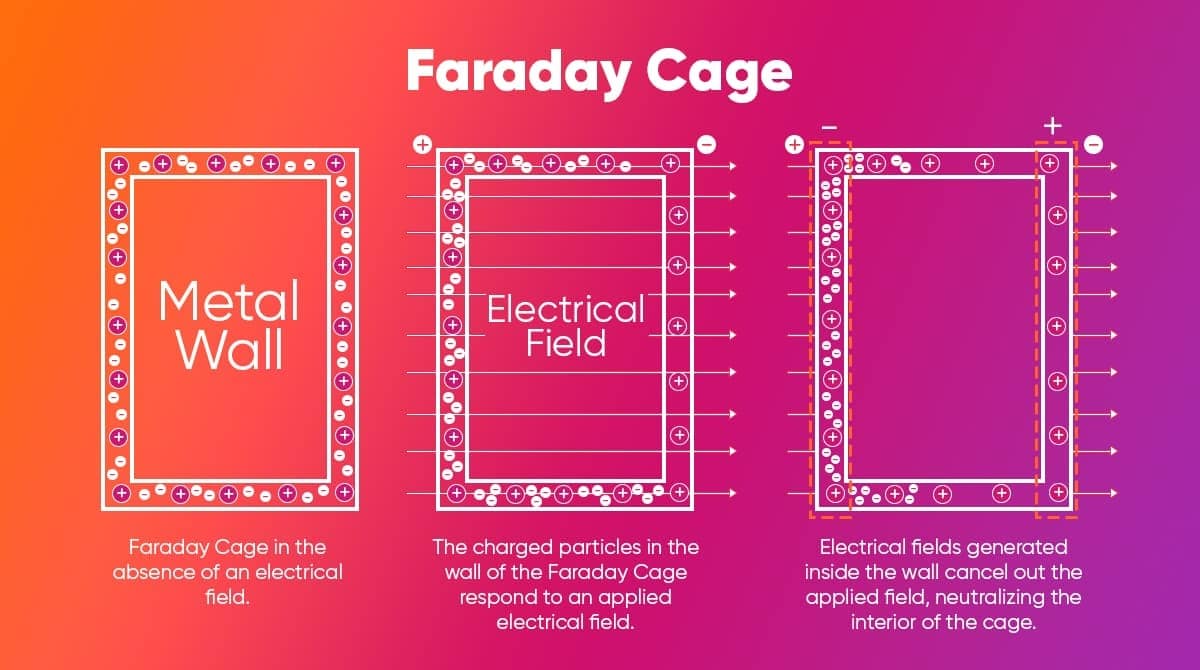
The same principle explains how a Faraday bag works: the conductive fabric forms a shielded enclosure that the external electromagnetic fields go around, not through, so a phone inside cannot see cellular networks, GPS, WiFi or Bluetooth.
Types of Faraday Protection (Cages, Rooms, Boxes, Bags)
There are four main physical forms of Faraday shielding most people run into.
- Faraday cage: Rigid metal or mesh enclosure that surrounds equipment or people to block external electromagnetic fields and RF signals.
- Faraday room: A room sized Faraday cage built from layered panels or mesh for MRI suites, secure labs, and equipment testing chambers.
- Faraday box: A rigid metal case that acts as a secure enclosure for multiple devices, used for EMP protection, lightning related surge protection and industrial EMI control.
- Faraday bag / pouch: A flexible Faraday shielding pouch made from conductive material, sized for mobile phone, tablets, laptops, RFID cards and key fobs, that blocks incoming and outgoing wireless signals.
All of them rely on the same idea: surround electronic equipment with conductive material so external electromagnetic fields and unwanted signals are forced around the outside.
At a Glance: Common Faraday Options
| Solution type | Typical material | Main purpose | Common uses | Portability | Notes |
| Faraday cage | Metal mesh or sheets | Block external RF signals and electric fields | Lab test enclosures, power equipment, vehicle bodies | Low | High shielding when continuous and grounded; used for industrial EMI control, lightning protection and protecting sensitive electronic equipment. |
| Faraday room | Layered mesh and sheet metal | High performance electromagnetic shielding of a space | MRI suites, data centers, secure rooms | Very low | Custom engineered, higher cost but robust for critical electronic systems and EMP protection. |
| Faraday box | Rigid conductive metal case | Protect specific devices from electromagnetic pulses and RF interference; reduce emissions | Instrument cases, backup electronics, digital forensics | Medium | Great for multiple devices and repeatable equipment testing; more predictable than DIY aluminum foil projects. |
| Faraday bag / pouch | Conductive fabric layers | Block wireless signals for privacy and digital security | Phones, keyless car fobs, RFID cards, laptops | High | Lightweight everyday carry; test with a phone inside or car key to confirm blocking signals across key RF frequencies. |
Quick way to choose:
- Want everyday privacy and peace of mind for a phone, car key or cards? Use Faraday bags or Faraday pouches.
- Want to protect sensitive electronic equipment and protect devices from EMP or lightning? Look at Faraday boxes and cages.
- Running MRI, secure networks or big electronic systems? You are in Faraday room and cage territory.
What Does Faraday Protection Actually Protect Against?
Faraday protection mitigates several types of electromagnetic threats by steering electromagnetic energy around sensitive electronics and away from your data.
Main categories:
- Everyday electromagnetic interference
- Cuts RF interference from WiFi signals, Bluetooth signals, and other RF signals around sensitive electronics and electronic components.
- Example: a shielded enclosure around a receiver so external electromagnetic radiation and signals do not spoil your measurements.
- Lightning and electrostatic discharge
- A Faraday cage routes lightning around the protected volume instead of through it, reducing the chance you damage electronic equipment or sensitive electronics.
- Example: the metal body of a car acting as a partial Faraday cage in a storm.
- Electromagnetic pulses and high energy spikes
- Faraday rooms and boxes reduce induced currents from electromagnetic pulses and some solar flares that could otherwise damage electronic systems.
- Tracking, car theft and signal based data theft
- Faraday bags protect mobile phone, keyless car fobs and RFID cards from radio frequency attacks and data extraction by blocking signals from cellular networks, GPS, WiFi and other external signals.
- Example: law enforcement uses Faraday bags to keep seized phones isolated so no one can remotely wipe or access sensitive data.
No Faraday solution is perfect. Shielding performance depends on continuity, grounding, enclosure size, RF frequencies and field strength, so gaps or very high frequency electromagnetic waves can still leak through. That is where good design choices come in.
Core Design Principles (Why Some Shields Work Better)
You can tell a lot about how well a Faraday product will protect devices by three simple things.
Continuity
- The conductive layer must wrap the protected devices with no big breaks.
- Loose flaps, weak zips or open cable holes become paths for unwanted external electromagnetic fields and unwanted signals.
Materials
- Cages and rooms use copper, aluminium or steel meshes and sheets.
- Faraday bags and wallets use fabric woven with metal fibres in multiple layers.
- Even simple aluminum foil can act as a basic Faraday shield around small multiple devices if you fully wrap them.
Grounding
- For lightning, static and strong EMP, grounding is critical so charges leave the shield safely.
- For small RF only shields, the Faraday cage or box will still work without a ground connection, but grounding improves performance in harsh environments.
Higher end boxes and rooms use conductive gaskets, filtered feedthroughs and waveguides to keep electromagnetic shielding strong while still allowing power, data and ventilation.
Closing Thoughts
In short, Faraday protection gives you a simple protective barrier between your electronic devices and the sea of wireless signals around you. It will not solve every problem in an instant, but it does give you a lot more control over when your phone, laptop or key fob can talk to the outside world.
If you want something that is already tested and ready to go, EMF Protection’s Faraday bags, backpacks, canopies and other Faraday products are designed to wrap your everyday electronic devices in proven shielding, so you can carry on with life while your tech stays that bit more private and protected.
At EMF Protection, we believe everyone deserves to live and work in a healthier environment. Our range of tested shielding fabrics, clothing, and bed canopies are designed to help you make that possible.If you’d like expert guidance or reliable products to reduce your exposure, contact us today!
Quick FAQs
Not quite. Faraday protection is the overall idea of blocking external electromagnetic signals with conductive material, and a Faraday cage is just one way to do it alongside Faraday bags,
Faraday boxes and Faraday rooms.
No. They block or attenuate signals over certain RF frequencies and strengths. Very high frequency radio signals, very strong fields or leaky seams can still get through.
For lightning, static and EMP protection the honest answer is yes, grounding is important. For small RF shields, it can work without earth, but grounded is safer and offers better shielding in tough conditions.
A continuous, grounded metal shell can protect people and electronic equipment from lightning by carrying current around them. Cars and planes are real world examples of Faraday cages work in action.
You will likely benefit if you park a keyless car outside, travel with sensitive data, work around digital forensics or simply want to shut off external communication on your phone inside a bag sometimes.
Yes for basic needs. Wrap the device in multiple layers of metal foil or place it in a metal tin with a snug lid, then test: call the phone, send a text or try the car key next to your car.
Faraday protection is one form of EMF shielding, focused on fully or almost fully enclosing the space. Other EMF protection products for the home may absorb or partially block electromagnetic fields, but they are not always full Faraday enclosures.