

EMF and male fertility is one of the most searched questions about phones and wireless devices, and the most accurate answer today is that the human evidence is uncertain, not settled in either direction. In 2024, systematic reviews commissioned by the World Health Organization (WHO) rated the human evidence linking radiofrequency electromagnetic fields (RF-EMF) to sperm quality as very low certainty. One large Swiss study did link frequent phone use with lower sperm concentration, but it could not show cause.
For couples trying to conceive, and for anyone rethinking where they keep their phone, the useful question is which studies to trust. Lab, animal and human studies point with very different strengths, and the sections below rank them, then cover female fertility, practical steps and the tests that matter most.
Reading this research correctly matters because infertility is common. The WHO estimates that around 17.5% of adults, roughly 1 in 6, experience infertility, and the American Society for Reproductive Medicine (ASRM) reports that male factors are involved in about half of infertile couples. Overrating the EMF findings can delay a semen analysis that finds a treatable cause. Dismissing them ignores questions researchers are still actively studying. Both mistakes cost couples time.
Detect EMF in Your Home
Does EMF Affect Fertility?
Current evidence does not show that everyday EMF from phones, Wi-Fi or power lines affects human fertility. WHO-commissioned reviews published in 2024 rated the human evidence as very low certainty, so the question remains open rather than answered.
Does EMF affect fertility? Current evidence does not show that everyday EMF exposure affects human fertility. WHO-commissioned systematic reviews published in 2024 rated the human evidence as very low certainty.
Some lab and animal studies have reported changes in sperm cells, but most used exposure levels well above the limits set for the public, often with long term exposure at close range. The US Food and Drug Administration (FDA) reviewed the published research from 2008 to 2018 and concluded there is no consistent or credible scientific evidence of health problems caused by radiofrequency energy from cell phones at or below the current limits. Neither the FDA nor the WHO-commissioned reviewers treat the open questions on fertility outcomes as evidence of adverse effects at everyday exposure.
What Does EMF Radiation Mean in Reproductive Health Research?
In reproductive health research, EMF radiation usually means radiofrequency electromagnetic fields from mobile phones, Wi-Fi routers, laptops and other wireless devices, and less often the extremely low frequency fields around power lines and household wiring. Both are non-ionizing radiation: they do not carry enough energy to break chemical bonds directly. That separates them from ionizing radiation, such as the X-rays and gamma rays used in radiotherapy, which is a recognized cause of reduced sperm production at treatment doses.
RF-EMF exposure from a phone is measured as the specific absorption rate (SAR), the rate at which the body absorbs radiofrequency energy. The Federal Communications Commission (FCC) limits phones sold in the US to a SAR of 1.6 W/kg, averaged over 1 gram of tissue. That figure matters when you read fertility studies, because many lab experiments exposed sperm or animals to levels far above it.
The Evidence Ladder: How Much Each Type of Study Can Tell You
The type of study decides how much a fertility finding tells you about everyday phone and Wi-Fi use. Lab and animal studies show what can happen under controlled, often high, exposure. Human observational studies and systematic reviews show what is actually seen in real populations. The table below ranks the main study types used in EMF and fertility research, with a published example of each.
| Study type | Example | What it reported | What it cannot show | Weight for everyday use |
|---|---|---|---|---|
| Lab studies on human sperm (in vitro) | Avendaño et al., 2012: samples from 29 donors placed under a Wi-Fi laptop for 4 hours | Progressive motility fell by about 25% vs 14% in controls; DNA fragmentation 9% vs 3% | Sperm in a dish lack the body’s blood flow, tissue and temperature control | Low |
| Animal studies | Cordelli et al., 2024: 117 studies in rats, mice, guinea pigs, hamsters and rabbits | Lower pregnancy rates in exposed animals, at an average exposure of 23.87 W/kg | Results come from exposures far above public limits, in other species | Low for everyday exposure |
| Human observational studies | Rahban et al., 2023: 2,886 Swiss men aged 18 to 22 | Median sperm concentration about 21% lower in men using a phone more than 20 times a day | Phone use was self-reported; the design cannot prove cause | Moderate signal, unconfirmed |
| Systematic reviews with meta-analysis | Kenny et al., 2024, commissioned by the WHO: 9 human studies | Little to no change in semen measures per hour of daily phone use | Limited by the quality of the studies it pools | Highest available |
| Regulator positions | FDA, 2020; ARPANSA, 2024 | No consistent evidence of health effects below exposure limits | Summarizes existing evidence rather than adding new data | Current public health baseline |
Most alarming headlines about EMF and sperm quality draw on the top two rows. The current scientific position draws on the bottom two.
What Did the 2024 WHO Systematic Reviews Find?
The 2024 WHO-commissioned systematic reviews found no conclusive evidence that RF-EMF exposure affects male fertility. The WHO ordered separate reviews of human observational studies and of experimental studies, and both graded the certainty of every pooled result, which earlier reviews often did not do. Australia’s radiation regulator, ARPANSA, summarized the human review as showing little evidence of an association between RF-EMF and male fertility.
Human Observational Studies
The human review by Kenny and colleagues screened more than 20,000 articles and included 9 human observational studies: 7 on mobile phone exposure in the general public and 2 on occupational exposure to radar or communications transmitters. It ran a dose response meta-analysis, which estimates the change in sperm quality for each extra hour of daily phone use. The four pooled results were:
- Sperm concentration: 1.6 million/mL higher per hour of use, with a range from 1.7 million lower to 4.9 million higher.
- Progressive sperm motility: 0.46 percentage points lower, with a range from 1.04 lower to 0.13 higher.
- Total sperm count: 0.44 million lower per ejaculate, with a range from 2.59 million lower to 1.7 million higher.
- Abnormal sperm morphology: 0.15 percentage points more abnormal forms, with a range from 0.21 fewer to 0.51 more.
Every one of those ranges includes zero, and the authors rated all four as very low certainty, mainly because the studies measured exposure crudely, often by asking men how much they used their phones. The two occupational exposure studies reported differences in sperm concentration, motility and morphology, but they could not be pooled and carried a high risk of bias.
Animal and Lab Studies on Human Sperm
The experimental review by Cordelli and colleagues covered 117 animal studies and 10 studies of human sperm exposed in vitro. In animals, exposure was linked to a lower pregnancy rate with moderate certainty, while litter size showed no change. ARPANSA points out that this pregnancy finding came from an average exposure of 23.87 W/kg, far above the public limit for whole-body exposure. In the human sperm studies, sperm vitality showed a small decrease, DNA and chromatin showed no change, and the certainty was very low. ARPANSA also notes that 75 to 80% of those human sperm studies used exposure levels above safety limits.
Why Earlier Reviews Reached Stronger Conclusions
Earlier reviews reached stronger conclusions because they pooled different study types together without grading certainty. A widely reported 2014 meta-analysis led by the University of Exeter combined 10 studies and 1,492 samples, including lab exposures, and found reduced sperm motility, about 8 percentage points lower on average, with less clear effects on concentration. The 2024 WHO-commissioned reviews separated human, animal and in vitro evidence and rated each, which is why their conclusions are more cautious. Neither approach proves or rules out an effect; they answer different questions.
What Did the Swiss Study of 2,886 Men Find?
The Swiss study by Rahban and colleagues found that frequent mobile phone use was associated with lower semen quality, specifically lower sperm concentration and total sperm count, in young men, but not with sperm motility or morphology. Researchers in Geneva and Basel analyzed semen samples from 2,886 men aged 18 to 22, recruited at military conscription centers between 2005 and 2018, and published the results in Fertility and Sterility in 2023.
Men who used their phones more than 20 times a day had a median sperm concentration of 44.5 million/mL, compared with 56.5 million/mL in men who used them once a week or less, a difference of about 21%. Both figures sit well above 15 million/mL, the level below which, the study summary notes, conception may take more than a year. Three further details from the study’s own summary shape how far the finding reaches:
- The association weakened over time. It was strongest in 2005 to 2007 and smaller in later years, which the authors link to the move from 2G to 3G and 4G networks and their lower phone transmitting power.
- Where the phone was kept made no clear difference. Too few men kept their phones away from the body for the researchers to draw a firm conclusion on pocket carrying.
- Phone use was self-reported. Reported frequency of use may not match real RF-EMF exposure, and the mechanism remains unknown.
The authors described their own finding as an association and called for follow-up work that measures exposure directly with a smartphone app. That is the right reading: the study is a reason for better research, not proof that phones lower sperm count.
Why Don’t Lab Results Settle the Question?
Lab results don’t settle the question because the exposure level, the tissue and the timescale in a lab differ from everyday life. Three gaps explain most of the distance between a striking lab finding and a real-world effect on human fertility.
Electromagnetic Field Exposure in Studies vs Everyday Life
Electromagnetic field exposure in many animal studies and vitro studies is prolonged and delivered at a fixed, close distance, often above the limits that apply to phones. A phone in daily use transmits at varying power depending on signal strength and network, and spends much of the day away from the body. A result seen at high exposure levels does not show what happens to human reproduction at typical human exposure across whole human populations.
Oxidative Stress and Other Proposed Mechanisms
Oxidative stress is the biological mechanism most often proposed in lab papers. Reviews of experimental studies describe exposed reproductive cells producing more reactive oxygen species, unstable molecules that can cause DNA damage and DNA fragmentation in sperm cells. These biological effects have been reported in cell and animal models. Animal papers also describe germ cell death, increased oxidative stress and changes in cell proliferation in the testes after high or long term exposure. No human study has yet confirmed that everyday RF-EMF exposure raises oxidative stress in the testes enough to change sperm function.
Heat and the Reproductive Organs: A Better-Understood Factor
Heat affects the male reproductive organs in a better-understood way than EMF, and it can confuse EMF studies. Sperm production works best a little below core body temperature, which is why the testes sit outside the body. In a 2005 study of 29 men, a working laptop on the lap raised scrotal temperature by up to 2.8°C within an hour, compared with 2.1°C from the seated posture alone. The Swiss researchers also asked whether any phone effect might act through testicular temperature rather than radiation emitted by the device.
Does EMF Lower Testosterone or Disrupt Hormonal Balance?
Human evidence on EMF, testosterone and hormonal balance is too limited to support a conclusion. The 2024 WHO-commissioned human review pooled semen measures only and produced no pooled estimate for hormone levels. Reports of hormonal disruption, hormonal alterations and decreased testosterone levels come mainly from animal studies of the Leydig cells, the testosterone-producing cells of the testes, often at high exposure levels.
What About EMF and Female Fertility?
EMF and female fertility has been studied less than male fertility, and a 2024 WHO-commissioned review rated all of the evidence on female reproductive health outcomes as very low certainty. The review by Johnson and colleagues included 18 human observational studies: 8 on mobile phone exposure in the general public and 10 on occupational exposure, mostly physiotherapists using shortwave diathermy equipment.
For mobile phone exposure, the pooled estimates for preterm birth (relative risk 1.14, range 0.97 to 1.34) and low birth weight (1.14, range 0.96 to 1.36) both included no effect. Small for gestational age (1.13, range 1.02 to 1.24) did not, but it rested on only 2 studies. For occupational exposure, miscarriage showed no clear dose response (odds ratio 1.02, range 0.94 to 1.10). The authors concluded that the body of evidence is very uncertain and called for more rigorous prospective studies.
Studies of female mice exposed to EMF, and lab studies of rat granulosa cells from the ovary, have reported changes in ovarian function, fetal development and markers of developmental toxicity, but they face the same exposure-level questions as the male studies. ARPANSA notes that the WHO-commissioned reviews of human and animal studies found no consistent adverse pregnancy effects.
How to Read an EMF Fertility Headline: A 5-Point Check
A five-point check sorts most EMF fertility headlines into useful evidence or noise. Run any new study, news story or blog claim through these questions before acting on it.
- Identify what was exposed. Sperm in a dish, animals and people give answers of very different strength.
- Compare the exposure level with the limit. A result at many times the FCC’s 1.6 W/kg phone limit says little about normal phone use.
- Check how exposure was measured. Self-reported hours of phone use are a weak proxy; measured exposure is stronger.
- Look for a graded systematic review. One study can be an outlier; a review that rates certainty shows where the whole body of evidence sits.
- Ask what else could explain the result. Heat, sitting time, smoking, weight and other environmental factors all affect sperm quality and can travel with heavy device use.
A claim that fails three or more of these checks is a hypothesis, not a finding.
How Can You Minimize EMF Exposure if You Choose To?
If you prefer to reduce EMF exposure and avoid unnecessary exposure from devices while research continues, distance and duration are the two factors you control, because RF-EMF levels fall quickly as a device moves away from the body. These steps lower measured exposure; they have not been shown to change fertility outcomes, and none replaces a medical assessment.
- Use speakerphones or a wired headset for long calls. An air-tube headset keeps the phone itself at arm’s length during calls.
- Carry your phone in a bag or jacket rather than a front trouser pocket, if you would rather keep it away from the body.
- Put your laptop on a desk rather than your lap, which also avoids the scrotal temperature rise measured in laptop users.
- Connect by Ethernet cable at home where convenient. A wired connection lets you switch Wi-Fi off, at night or all day, if you prefer.
- Switch on airplane mode when your phone is in your pocket and you do not need it.
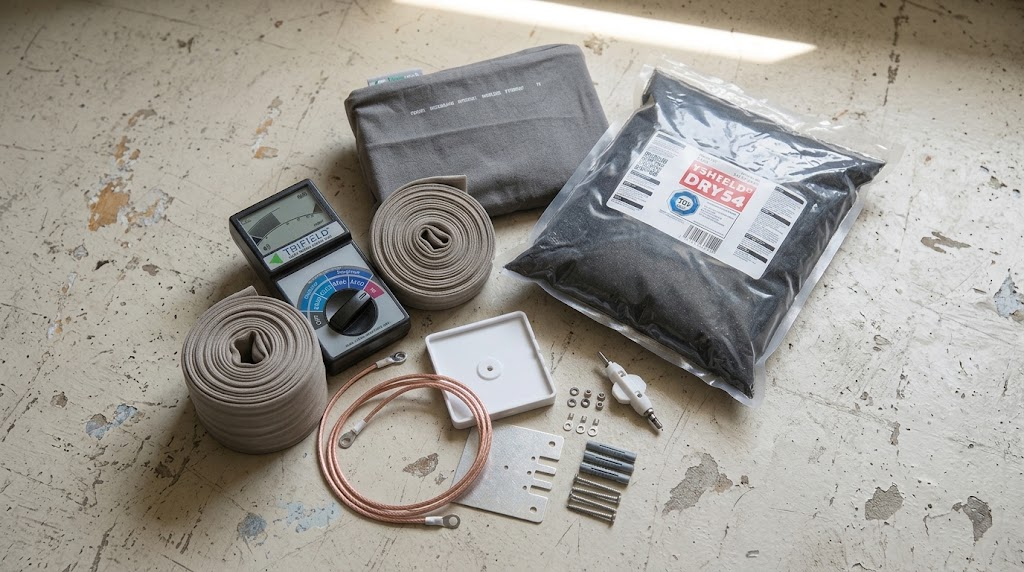
- Measure before you change anything. An RF meter shows how readings change with distance from your phone and router, so you can see which changes make a measurable difference.
If you are unsure what to measure first, the EMF Protection team offers free advice on measuring your home.
What Should You Check First if You Are Trying to Conceive?
A semen analysis is the first test to check male fertility, and it answers more than any review of EMF research can. ASRM recommends that a male fertility evaluation starts with a medical and reproductive history and one or more semen analyses, which measure sperm count, sperm motility and morphology.
If the results are abnormal, the next step is a urologist who specializes in male infertility, who may order hormone testing when the total motile sperm count is below 15 million, or genetic testing when it is below 5 million. Many causes found this way are treatable, which is why testing comes before lifestyle guesswork.
Your next step: if you have been trying to conceive without success, book a semen analysis through your doctor alongside the female partner’s assessment. If you also choose to lower your device exposure, measure your phone, laptop and router first, then change the habits that move the readings most.
Detect EMF in Your Home | Shop EMF Shielding Paints
Common Questions About EMF and Fertility
Three questions about EMF and fertility come up most often beyond the main research findings, and each has a short, sourced answer.
Wi-Fi has not been shown to affect sperm in people. The best-known Wi-Fi study placed sperm samples under a connected laptop in a lab for 4 hours, and human studies have not confirmed its result. The WHO-commissioned 2024 reviews rated lab findings on human sperm as very low certainty.
Ionizing radiation at medical treatment doses, such as radiotherapy, can reduce sperm production. The non ionizing radiation emitted by phones, Wi-Fi and power lines works differently, and current human evidence does not show that it causes infertility in men.
Mobile phone radiation, the radiofrequency radiation phones use to reach the network, has been associated with lower sperm concentration in one large Swiss study of 2,886 men, but the WHO-commissioned dose response meta-analysis of 9 human studies found little to no change, rated as very low certainty. The link is unconfirmed.


