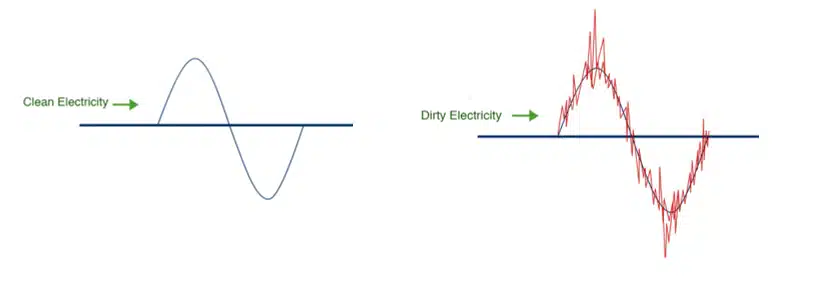
Dirty electricity filters work at one measurable job: they reduce high-frequency voltage on the circuit they plug into, within the frequency range their capacitor covers. They do not save money on a household electric bill, because US homes pay for real power in kilowatt-hours and a filter does not reduce it. Knowing both answers before you buy stops you paying for a promise a filter cannot keep.
Below you will find what a dirty electricity filter does inside, what the evidence shows, why bill savings claims fail, how plug-in and whole-house filters differ, and when a filter is the wrong fix. If you are still working out whether you have dirty electricity at all, start with what dirty electricity is and the signs to look for.
The short answer
- Filters work electrically: a line noise meter shows lower high-frequency voltage on the circuit after you plug one in.
- Filters do not save money: residential meters bill real power, and a filter’s reactive current is not billed.
- Filters do not reduce Wi-Fi or cell signals, magnetic fields, or the normal 60 Hz electric field from wiring.
- Reviews of the research have not shown health benefits from filters.
- Measure before and after; expect a reduction, not zero.
What Does a Dirty Electricity Filter Do?
A dirty electricity filter is a capacitor connected across the hot and neutral wires of an outlet, which gives high-frequency electrical noise a low impedance path while letting the 60 Hz sine wave of the supply pass almost untouched. That is how plug-in filters filter dirty electricity, also called high-frequency voltage transients. Researchers describe the Graham-Stetzer design the same way: a capacitor that inserts “a low impedance path between the wires over the relevant frequency range” (de Vocht and Olsen, 2016).
A capacitor’s opposition to alternating current, called reactance, falls as frequency rises. The EMF Protection Dirty Electricity Filter uses a 10 microfarad mains-rated capacitor, with a discharging resistor, a fuse and an electric field screen connected to the earth pin. The table shows what that 10 µF capacitor looks like to signals at different frequencies, using the standard reactance formula Xc = 1 / (2πfC).
| Frequency | What it is | Reactance of a 10 µF capacitor | What happens |
|---|---|---|---|
| 60 Hz | US mains supply | 265 ohms | The supply passes; the capacitor draws a small reactive current |
| 1 kHz | Harmonic range | 15.9 ohms | Partial shunting |
| 10 kHz | Lower end of line noise meters | 1.6 ohms | A low impedance path for noise |
| 100 kHz | Upper end of the Stetzer meter range | 0.16 ohms | A very low impedance path |
| 1 MHz | AM radio band | 0.016 ohms | Lowest in theory; wiring and lead inductance limit real performance |
Interactive block in the HTML version: Filter reactance explorer. A slider from 60 Hz to 1 MHz shows the reactance of a 10 µF filter capacitor at each frequency and labels the region (mains, harmonics, line noise, AM band), so readers can see why the filter passes 60 Hz and shunts kilohertz noise.
The result in a real home depends on where the noise source sits. Common sources include switching power supplies in chargers and electronics, dimmer switches, LED bulbs and older CFL bulbs. A filter plugged into the same circuit as a noisy charger acts close to the source; a filter on a distant circuit only sees the noise after it has crossed the panel and other wiring.
What Dirty Electricity Filters Do Not Do
- Filters do not eliminate dirty electricity; they reduce it on the circuits where they are plugged in.
- Filters do not reduce radio frequency signals or the electromagnetic field from Wi-Fi routers, phones or cell towers, which travel through the air rather than along the wiring.
- Filters do not reduce magnetic fields from current flowing in appliances and wiring.
- Filters do not lower the normal 60 Hz electric field from house wiring; EMF Protection’s product page states this directly.
- Filters do not replace a surge protective device, a GFCI or an AFCI, and they are not electrical safety devices.
- Filters do not remove noise outside the range their capacitor and wiring can shunt, so a line noise meter will not read zero.
Do Dirty Electricity Filters Work? What the Evidence Shows
Dirty electricity filters do work electrically: plugging one in reduces the measured high-frequency voltage on that circuit within the filter’s working range, and a dirty electricity meter confirms the change in dirty electricity levels in a few minutes. Studies have used the Stetzer meter for this; the Line EMI Meter does the same job across a wider range. That is a physical claim you can test in your own home.
Health claims made for filters are a different matter. A 2016 systematic review found that the evidence for dirty electricity as a health exposure “does not stand up to scientific scrutiny”, with most studies relying on self-reported outcomes and filter interventions that were not blinded (de Vocht and Olsen, 2016). EMF Protection sells filters for people who choose to reduce measured line noise, not as a health product.
How to Check Your Dirty Electricity Filters Are Working
- Take a reading with a line noise meter at the outlet you plan to use, with no filter plugged in. Note the mVp-p figure.
- Plug the filter into the same outlet or another outlet on the same circuit, let the reading settle and note it again.
- Repeat at two or three other outlets on that circuit and on one neighboring circuit.
- Compare each pair of readings. The Line EMI Meter is accurate to within 8% between 20 kHz and 2 MHz, so treat smaller changes as measurement noise.
Expect a reduction, not zero. EMF Protection’s own meter page notes that the meter covers a wide frequency range and that filters usually target only part of it.
Do Dirty Electricity Filters Save Money on Your Electric Bill?
No, dirty electricity filters do not save money on a home electric bill. Residential meters bill real power in kilowatt-hours. A capacitor across the line draws reactive current, which a home meter does not charge for, and it does not reduce the real power used by anything else in the house.
The numbers show why. At 120 volts and 60 Hz, a 10 µF capacitor draws about 0.45 amps of reactive current, roughly 54 volt-amperes reactive. That current flows back and forth without doing work, so it adds nothing to the kilowatt-hour total and takes nothing away from it. The discharging resistor inside a filter uses a tiny amount of real power, so a filter’s effect on a bill is, if anything, a tiny increase rather than a saving.
Independent tests of “power saver” boxes, which typically rely on capacitors to correct power factor, agree. The National Rural Electric Cooperative Association reports that engineers at the University of Texas at Austin measured no more than a 0.06% reduction in electric use from one unit, and EPRI found average savings of 0.23% from another popular product (NRECA).
| Claim you may see | What actually happens | Source |
|---|---|---|
| “Cuts your bill by up to 30%” | Tested savings were 0.06% to 0.23% | NRECA |
| “Corrects your home’s power factor” | Homes are billed on real power; reactive power is not gauged | Coosa Valley EC |
| “Saves energy by cleaning the power” | The filter shunts noise; the kWh meter reads the same | Reactive current physics |
If your bill falls after fitting filters, look for another cause first, such as weather, appliance use or a rate change. If a seller promises savings, ask for metered before and after kWh data from a home like yours. EMF Protection’s US product page makes no energy saving claim for its filters.
Plug-In vs Whole-House Dirty Electricity Filters
A plug-in dirty electricity filter works on the circuit it is plugged into, while a whole-house filter is wired into the electrical panel by a licensed electrician and works on noise at the panel. Each reaches noise the other misses. Plug-in filters plug directly into standard outlets and can target specific circuits; whole home filters need professional installation by a qualified electrician but sit upstream of all other circuits.
| Feature | Plug-in filters | Whole-house (wire-in) filters | Panel surge protective device |
|---|---|---|---|
| Installation | Plug into a standard outlet | Licensed electrician at the breaker panel | Licensed electrician at the panel |
| Works on | That circuit, strongest near the filter | Noise arriving at or passing through the panel | Short surges and spikes |
| Noise from devices on branch circuits | Yes, when on the same circuit | Only after it reaches the panel | Not designed for it |
| Typical number | Several, spread across circuits | One unit | One unit |
| Required by code | No | No | Yes for dwelling services under NEC 2020 section 230.67, where adopted |
| Sold by EMF Protection | Yes | No | No |
For most homes, a practical whole house dirty electricity filter setup is a set of plug-in filters spread across the circuits that carry the most electronics, which is how EMF Protection’s multi-packs are meant to be used. A wire-in unit can make sense alongside them if your readings show noise arriving from outside, for example from solar inverters on a shared supply, but only a licensed electrician should fit one. The National Electrical Code’s 2020 edition requires a Type 1 or Type 2 surge protective device for dwelling services (Leviton); that device handles surges, not continuous line noise.
Do Greenwave Dirty Electricity Filters Work?
Greenwave filters work on the same principle as other plug-in dirty electricity filters: they plug into an outlet and reduce high-frequency voltage on that circuit, which you can check with a line noise meter. Greenwave is a separate brand designed for US and Canadian power systems, with a pass-through outlet so the socket stays usable (LessEMF listing). EMF Protection does not sell Greenwave filters. The same test applies to any brand: measure before and after, expect a reduction rather than zero, and treat health or bill claims with the caution set out above.
Can You Build a DIY Dirty Electricity Filter?
You can find DIY dirty electricity filter plans online, but building one means wiring a capacitor directly across a live 120-volt supply, and a manufactured, fused filter is the safer choice for most people. A capacitor across the line has to be a Class X safety capacitor, usually X2 for household circuits, because it is exposed to every surge on the line and must fail in a controlled way (All About Circuits).
A safe plug-in filter design needs all four of these parts:
- An X2-rated capacitor with the right voltage rating, not a general-purpose capacitor.
- A bleed resistor, so the plug pins do not hold a charge after you unplug it.
- A fuse sized for the capacitor’s current.
- A fully enclosed, non-conductive housing with strain relief on any leads.
Miss one of these and the result is a shock or fire risk in an outlet you may leave plugged in for years, with no testing behind it.
When a Dirty Electricity Filter Is the Wrong Fix
A filter is the wrong first step for reducing dirty electricity when the noise source is easy to remove, or when the problem is not line noise at all.
- Remove the source first. Replacing a mismatched dimmer, a noisy LED bulb or a cheap charger stops noise where it starts instead of shunting it. See our guide to how to reduce dirty electricity in your home.
- Call an electrician for faults. Flicker across the whole house, warm outlets or buzzing breakers point to wiring problems that a filter will not fix; fix underlying wiring problems before installing filters.
- Use the right tool for wireless signals. If your concern is Wi-Fi or cell signals, a filter on the wiring will not change them; see our guide to detecting electromagnetic radiation.
- Measure before you scale up. Start with two filters on the circuits you use most, measure, then add more where readings stay high. If you prefer a professional survey, an electrician or building biologist with a line noise meter can measure your circuits for you.
Your next step: measure one busy circuit, add one filter, and measure again. If the readings fall and you want to cover more circuits, our comparison of the best dirty electricity filter kits for 2027 shows how many filters suit each size of home.
Dirty Electricity Filter FAQs
A dirty electricity filter reduces high-frequency voltage noise on the circuit it plugs into by giving that noise a low impedance path through a capacitor, while the 60 Hz supply passes almost unchanged.
A dirty electricity filter will not reduce a home electric bill. Homes are billed for real power in kilowatt-hours, and independent tests of capacitor-based power saver devices found savings of 0.06% to 0.23%.
EMF Protection suggests starting with two dirty electricity filters in the areas where you spend most time, then adding more where a line monitor shows noise staying high, up to 4 filters per room.