
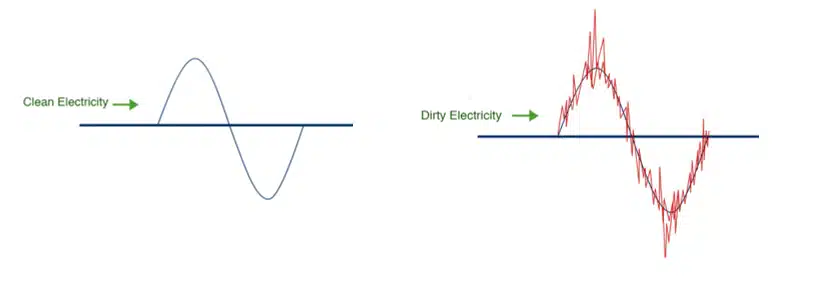
Dirty electricity is the everyday name for high-frequency electrical noise that rides on top of the smooth 60 Hz power in your home’s wiring. Electricians and engineers call the same thing line noise, conducted interference or a power quality problem, and it is real and measurable with the right meter. What dirty electricity does to people is a separate question, and the scientific evidence there is weak; this guide covers both honestly.
Getting the diagnosis right matters for two practical reasons. Several signs people blame on dirty power, such as flickering lights or a warm outlet, can also point to a loose connection that needs an electrician, not a filter. And if the noise really is there, knowing where it comes from tells you whether swapping one dimmer or adding a set of filters is the sensible fix.
Dirty electricity in 30 seconds
- Dirty electricity is high-frequency voltage noise, mostly in the kilohertz range, carried on 60 Hz household wiring.
- Switch-mode power supplies in chargers, TVs, LED drivers and computers are the most common source.
- Common signs are electrical: LED flicker on dimmers, buzzing, and AM radio static near devices.
- A plug-in line noise meter is the only direct way to confirm it and to check any fix.
- Reviews of the research have not shown that dirty electricity affects health, and it does not meaningfully raise a home electric bill.
What Is Dirty Electricity?
Dirty electricity is unwanted voltage at frequencies far above the 60 Hz of US mains power that travels along household circuits alongside the normal supply. Researchers describe it as high-frequency voltage transients (HFVT), usually measured between the hot and neutral wires at an outlet (de Vocht and Olsen, 2016).
Picture clean power as a smooth, slow wave of alternating current that repeats 60 times a second at about 120 volts. Dirty electricity is the fast, jagged ripple layered on that wave each time a device switches current on and off in short bursts. The ripple is small in voltage but high in frequency: the Graham-Stetzer microsurge meters used in published studies read from 10 kHz to 100 kHz and report in GS units, a measure of how fast the voltage changes, while the Dirty Electricity Line EMI Meter reads from 10 kHz to 10 MHz in millivolts peak to peak.
Figure (built into the HTML as an SVG): A clean 60 Hz supply (top) and the same supply carrying high-frequency noise from switching electronics (bottom). Illustrative, not to scale. Alt text: Clean 60 Hz sine wave compared with a wave carrying high-frequency dirty electricity
Dirty electricity is high-frequency electrical noise, mostly in the kilohertz range, carried on a home’s 60 Hz wiring. Engineers call it line noise or conducted interference, and a plug-in line noise meter can measure it at any outlet.
Dirty Electricity vs Dirty Power: What Each Term Means
Dirty power is the broader term: it covers every way a supply can drift from a clean 60 Hz sine wave, while dirty electricity usually means only the high-frequency part. Schneider Electric lists five dirty power problems: sags, swells and interruptions in voltage; transients and surges; harmonics or waveform distortion; voltage imbalance; and power frequency variations (Schneider Electric, 2023).
| Term | What it means | Timescale | Usual fix |
|---|---|---|---|
| Dirty electricity (line noise) | Fast voltage ripple from switching electronics | Kilohertz to megahertz, continuous while devices run | Remove or replace sources; plug-in filters |
| Harmonic distortion | Distortion at whole multiples of 60 Hz (120 Hz, 180 Hz and up) | Continuous | Better-designed equipment; harmonic filters in commercial buildings |
| Surges and voltage spikes | Short, high-voltage events from lightning, utility switching or sudden load changes | Microseconds to milliseconds | Surge protective device at the panel |
| Sags and swells (voltage fluctuations) | Voltage drops or rises on the supply | Fractions of a second to minutes | Utility repair, voltage regulator or UPS |
In commercial buildings and data centers, Schneider Electric links dirty power to equipment that overheats, transformer noise, premature motor failure and data loss in sensitive equipment, and puts the cost at about $15 billion a year. In a home, the effects are usually smaller and show up as interference: flicker, buzzing, and noise on audio or radio.
The difference matters when you shop for a fix. A surge protector at the panel is built for brief spikes, and it is not designed to filter the continuous kilohertz noise that a dimmer or charger produces.
What Causes Dirty Electricity in a Home?
Switch-mode power supplies, also called switching power supplies, cause most dirty electricity in homes, because they convert AC power to DC power by drawing current in rapid bursts instead of a smooth flow (TriField, 2025). These supplies sit inside almost every modern electronic device, from phone chargers and laptop bricks to TVs, LED drivers and games consoles. The ARRL’s laboratory manager, Ed Hare, put it plainly in 2015: “Every TV you own has a built-in switcher” (ARRL).
Other common sources are dimmer switches, solar inverters, variable-speed motors in HVAC systems, refrigerators and pumps, portable generators without inverter electronics, and radio signals picked up by the wiring itself. Upstream of your meter, Schneider Electric also lists aging infrastructure, faults in power generation and transmission equipment, utility switching, lightning and poorly regulated renewable energy sources on the utility grid. Even so, it reports that 80% of power quality issues originate on the customer’s side of the electric meter (Schneider Electric, 2023), so most of the noise in a typical home is made inside it, not delivered by the power company.
7 Common Signs of Dirty Electricity in Your Home
The signs of dirty electricity are electrical: noise you can hear on a radio, flicker you can see in a lamp, or a reading on a meter. Each sign below points to a likely source and a quick check. None of them proves dirty electricity on its own, so treat each one as a reason to measure.
1. LED Lights Flicker or Shimmer on a Dimmer
LED lights that flicker on a dimmer usually mean the dimmer and the LED driver are mismatched, and both switch current rapidly. Check: turn the dimmer to full brightness; if the flicker stops, the dimmer circuit is a likely noise source. If lights flicker across the whole house, or dip when a large appliance starts, call a licensed electrician, because that pattern can point to a loose or failing connection.
2. Dimmers, Bulbs or Chargers Buzz
A buzzing dimmer, bulb or charger is audible evidence of current being chopped many times a second. Check: switch the light off and on and listen at the switch plate and the fixture, or hold a charger to your ear while it charges. A buzzing breaker or outlet is different: treat it as an electrical fault, stop using that circuit and have it inspected.
3. An AM Radio Crackles Near Outlets and Devices
An AM radio picks up electrical noise because the AM broadcast band, about 540 to 1,700 kHz, sits inside the range that line noise meters read. Check: tune a portable AM radio between stations, then walk it slowly past outlets, chargers, lamps and the electrical panel. Static that rises near a device and drops when you unplug it marks a noise source.
4. Speakers or Audio Equipment Pick Up Hiss or Whine
Audio equipment that hisses or whines when a particular device switches on suggests noise traveling on the shared circuit. Check: switch devices off one at a time and note which ones change the sound. A steady low hum can also come from a ground loop between audio components, which is a cabling issue rather than line noise.
5. One Circuit Feeds Many Chargers and Power Bricks
A circuit crowded with switch-mode supplies is the most likely place to find high readings. Check: use the labels in your breaker panel to count the chargers, adapters, LED lamps and electronics on each circuit. A home office or an entertainment wall is a sensible first place to measure.
6. You Recently Added Solar, an EV Charger or a Variable-Speed System
Solar panels feed your home through an inverter. Solar inverters, EV chargers and variable-speed heat pumps all convert electrical power electronically, and older or lower-quality inverters add more line noise than true sine wave models (TriField, 2025). Check: compare readings with the inverter or charger running and switched off, during daylight for solar.
7. A Line Noise Meter Reads High Against Your Own Baseline
A plug-in line noise meter gives the only direct confirmation, because it measures the high-frequency voltage at the outlet itself. Check: take a reading with as much switched off as practical, then again with normal use, and compare. There is no official threshold for these readings, so the useful figure is the change between your own before and after readings.
Interactive block in the HTML version: Dirty electricity sign checker. Readers tick the signs they have noticed. The block lists the likely sources for each ticked sign, flags any wiring fault signs that need an electrician, and suggests the next step: walk test, meter reading or electrician.
These are not dirty electricity signs: Warm or discolored outlets, a burning smell, sparks or breakers that trip repeatedly point to wiring faults with a real fire and shock risk. Switch off the circuit and call a licensed electrician. A filter will not fix them.
How to Diagnose Dirty Electricity Step by Step
Diagnosing dirty electricity takes four steps: list the likely sources, run an AM radio walk test, take meter readings, then isolate circuits at the breaker panel.
- List the sources. Walk each room and note switch-mode devices, dimmers, LED fixtures, inverters and variable-speed appliances, grouped by circuit.
- Run the AM radio walk test. Tune between stations and note where static rises. Mark those outlets and devices.
- Take readings. Plug a line noise meter into each marked outlet (an oscilloscope can show the waveform itself, but needs training and safe probes) and note the figure in mV, then unplug or switch off nearby devices one at a time and note each change. The Line EMI Meter reads 0.1 to 1,999.9 mVp-p and is accurate to within 8% between 20 kHz and 2 MHz, so a change smaller than that can be measurement noise.
- Isolate circuits. With the meter’s own circuit left on, switch other breakers off one at a time and watch which ones lower the reading. This shows whether the noise starts in the room or travels from another circuit.
Write the readings down. They become the before figures you will compare against after any change, which is the only reliable way to tell whether a fix worked. Our guide to how to reduce dirty electricity in your home covers the fixes in order, starting with the cheapest.
Does Dirty Electricity Affect Health? What the Evidence Says
The current scientific evidence does not show that dirty electricity affects health. A 2010 review in the Journal of Exposure Science and Environmental Epidemiology found only seven relevant studies and concluded that flaws in their design, exposure assessment and statistics meant a causal link could not be validly assessed (de Vocht, 2010). A 2016 systematic review found that the evidence “does not stand up to scientific scrutiny” and that the widely quoted 50 GS unit threshold has no evidence behind it (de Vocht and Olsen, 2016).
The World Health Organization’s position on sensitivity to electromagnetic fields is consistent with this: well-controlled double-blind studies found that the complaints people reported were not correlated with EMF exposure (WHO). Some people still choose to lower the line noise in their homes, in the same way others prefer wired internet to Wi-Fi. That is a personal preference, and measuring is the honest way to act on it. If you have health concerns, speak to your doctor; a filter or a meter is not a medical device.
Does Dirty Electricity Raise Your Electric Bill?
Dirty electricity does not meaningfully raise a household electric bill, because US homes pay for real power in kilowatt-hours, not reactive power. Coosa Valley Electric Cooperative puts it simply: “Households, though, are billed on real power usage, meaning reactive power is not gauged” (Coosa Valley EC, 2023). Power quality correction matters to factories and large commercial sites that pay power factor charges, and claims that cleaning dirty power will improve energy efficiency come from those settings, not from a typical home. Our guide to whether dirty electricity filters work and save money runs the numbers in detail.
What to Do If You Find Dirty Electricity
If your readings or walk test point to noise, start with the sources, because removing a noisy charger or replacing a mismatched dimmer stops the noise where it starts and is the cheapest route to cleaner power. Then decide whether filtering the remaining circuits is worth it to you.
- Reduce it: follow our step-by-step guide to how to reduce dirty electricity in your home.
- Understand filters: read do dirty electricity filters work and save money? before you buy.
- Choose a kit: compare the best dirty electricity filter kits for 2027 by home size.
- Measure it: see the Dirty Electricity Line EMI Meter or our full range of EMF detectors and monitors.
Dirty Electricity FAQs
Yes, dirty electricity is real as a physical effect: high-frequency noise on household wiring is measurable, and the FCC limits how much noise electronic devices may conduct back onto the power line between 150 kHz and 30 MHz (47 CFR 15.107). What has not been established is any effect on health.
The signs of dirty electricity in a house are LED flicker on dimmers, buzzing dimmers or chargers, AM radio static near outlets, hiss on audio equipment and high line noise meter readings. Flicker across the whole house or warm outlets point to wiring faults instead.
A UPS (an uninterruptible power supply with battery backup) can clean the supply for the electrical devices plugged into it, especially an online (double-conversion) model, but it does nothing for the rest of the house and contains its own switching electronics. It suits a computer or network cabinet, not a whole home. An inverter generator produces cleaner power than a conventional portable generator, and an automatic voltage regulator corrects sags and swells, but neither filters the kilohertz noise made by devices inside your home.
Dirty electricity can be partly reduced at the breaker box: a licensed electrician can fit a wire-in filter at the panel, but a panel device cannot reduce noise made by a device on a branch circuit before it reaches the panel. Most fixes still happen at the source or the outlet.