
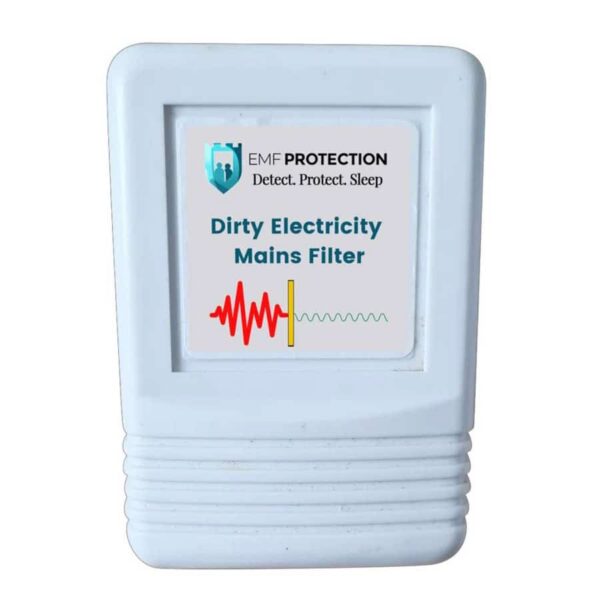
Dirty Electricity Filter
Price range: $59.99 through $799.99
Free Standard shipping over $100
Free Express shipping over $250
The Dirty Electricity Filter is a plug-in filter that reduces the high-frequency noise on your home wiring, also known as line noise or electrical noise. Plug it into an outlet and it starts working.
- Plug-in, with no wiring or setup needed
- Works on 100 to 240V circuits at 50 or 60 Hz, and we send the right plug for your address
- Available in multi-packs, with a free dirty electricity line monitor in the 15 pack
In stock
- Standard: Get it as soon as
- Express: Get it as soon as
- 30-day returns
- Free US shipping over $100
- Shielding specialists since 2004
- Free advice before you buy
Product details
Dirty Electricity Filter: Plug-In Filter for Your House Wiring
Dirty electricity is high-frequency noise travelling along wiring that should carry only 50 or 60 Hz power. It comes from electronics that convert alternating current to direct current, such as computers, televisions, phone chargers, low-energy light bulbs and dimmer switches. The Dirty Electricity Filter plugs into an outlet and reduces this noise between the live and neutral conductors. To learn more, read our guide to minimizing dirty electricity in your home, or watch our Dirty Electricity Explained video.
What Is Inside the Filter
Each filter contains a 10 microfarad AC mains-rated capacitor, a discharging resistor and a fuse. It also has an electric-field screen inside the case, connected to the earth pin, which greatly reduces the electric field around the outside of the filter. The filter reduces high-frequency noise only: it does not lower the normal electric fields created by your house wiring.
Test the Difference With a Line Monitor
To see what the filters do, measure the noise on your wiring with a Dirty Electricity Line EMI Meter with and without your filters plugged in. The 15 pack includes a free line monitor.
How Many Filters Do I Need?
Every home and room is different. As a starting point, we suggest at most one filter per room, and two for the whole house to begin with, in the areas where you spend most of your time. Then use a line monitor to check the noise that is left on nearby wiring, and add more filters where it stays high. Each filter plugs into an outlet. Our video Dirty Electricity Filters: How Many Do I Need and Where Do I Put Them? explains it in more detail.
Choose Your Pack
- Pack sizes: 1 filter ($59.99), 4 filters ($179.99, buy 3 and get 1 free), 12 filters ($479.99, buy 8 and get 4 free), or 15 filters with a free dirty electricity line monitor ($799.99).
- Plug type: we send the correct plug type for the address you use at checkout, either a standard US plug or type G. If it should be different, add a note to your order.
- Voltage: the filters work on 50/60 Hz AC circuits from 100V to 240V, so they can be used in many countries. If your outlets do not match the plug we send, for example the type G version in Europe, you will need an adapter.
- Pack Size
- 1 Filter, 4 Filters - Buy 3, Get 1 Free, 12 Filters - Buy 8, Get 4 Free, 15 Filters + Free DE Line Monitor
- Weight
- N/A
| Specification | Details |
|---|---|
| Type | Plug-in dirty electricity filter |
| Capacitor | 10 microfarad AC mains-voltage rated |
| Also contains | Discharging resistor and fuse; electric-field screen inside the case, connected to the earth pin |
| Voltage | 100V to 240V |
| Frequency | 50/60 Hz AC |
| Plug type | Standard US plug or type G; the correct plug is sent for the checkout address, or add a note to your order if it should be different |
| Pack sizes | 1 filter ($59.99); 4 filters ($179.99, buy 3 and get 1 free); 12 filters ($479.99, buy 8 and get 4 free); 15 filters with a free dirty electricity line monitor ($799.99) |
| Suggested use | One filter per room at most; start with two for the whole house |
A dirty electricity filter is a plug-in device that reduces high-frequency noise, also known as line noise or electrical noise, on your home wiring. You plug it into an outlet and it starts working.
Each filter contains a 10 microfarad AC mains-rated capacitor, a discharging resistor and a fuse. It reduces high-frequency noise between the live and neutral conductors. It does not lower the normal electric fields created by your house wiring.
Every home is different. Start with two for the whole house, in the areas where you spend most of your time, with at most one filter per room. Then use a line monitor to check the noise on nearby wiring and add more where it stays high. Our video How Many Do I Need and Where Do I Put Them? explains it in more detail.
Plug them into outlets in the rooms where you spend the most time, then check the noise on nearby wiring with a line monitor. The placement video shows where to put them.
Measure the noise on your wiring with a Dirty Electricity Line EMI Meter with and without your filters plugged in. The 15 pack includes a free line monitor.
They work on 50/60 Hz AC circuits with a voltage anywhere between 100V and 240V.
We send the correct plug type for the address you use at checkout, either a standard US plug or type G. If it should be different, add a note to your order.
Yes. The filters work on circuits from 100V to 240V at 50 or 60 Hz. We send the correct plug type for the address you use at checkout, and add a note to your order if it should be different. If the plug does not fit your outlets, for example the type G version in Europe, you will need an adapter.
Yes. Plug a filter into any outlet that matches its plug, or use an adapter, on a circuit between 100V and 240V.
1 filter ($59.99), 4 filters ($179.99, buy 3 and get 1 free), 12 filters ($479.99, buy 8 and get 4 free), or 15 filters with a free dirty electricity line monitor ($799.99).
A single filter is $59.99. A pack of 4 is $179.99 (buy 3, get 1 free), a pack of 12 is $479.99 (buy 8, get 4 free), and a pack of 15 with a free dirty electricity line monitor is $799.99.
Please see our returns policy for details.
Yes. If you are unsure how many filters your home needs, speak to an expert for free advice before you buy.
What customers say
 Dirty Electricity Filter
Price range: $59.99 through $799.99
Dirty Electricity Filter
Price range: $59.99 through $799.99